Memory
Textiles and Memory: Stories Held in Cloth
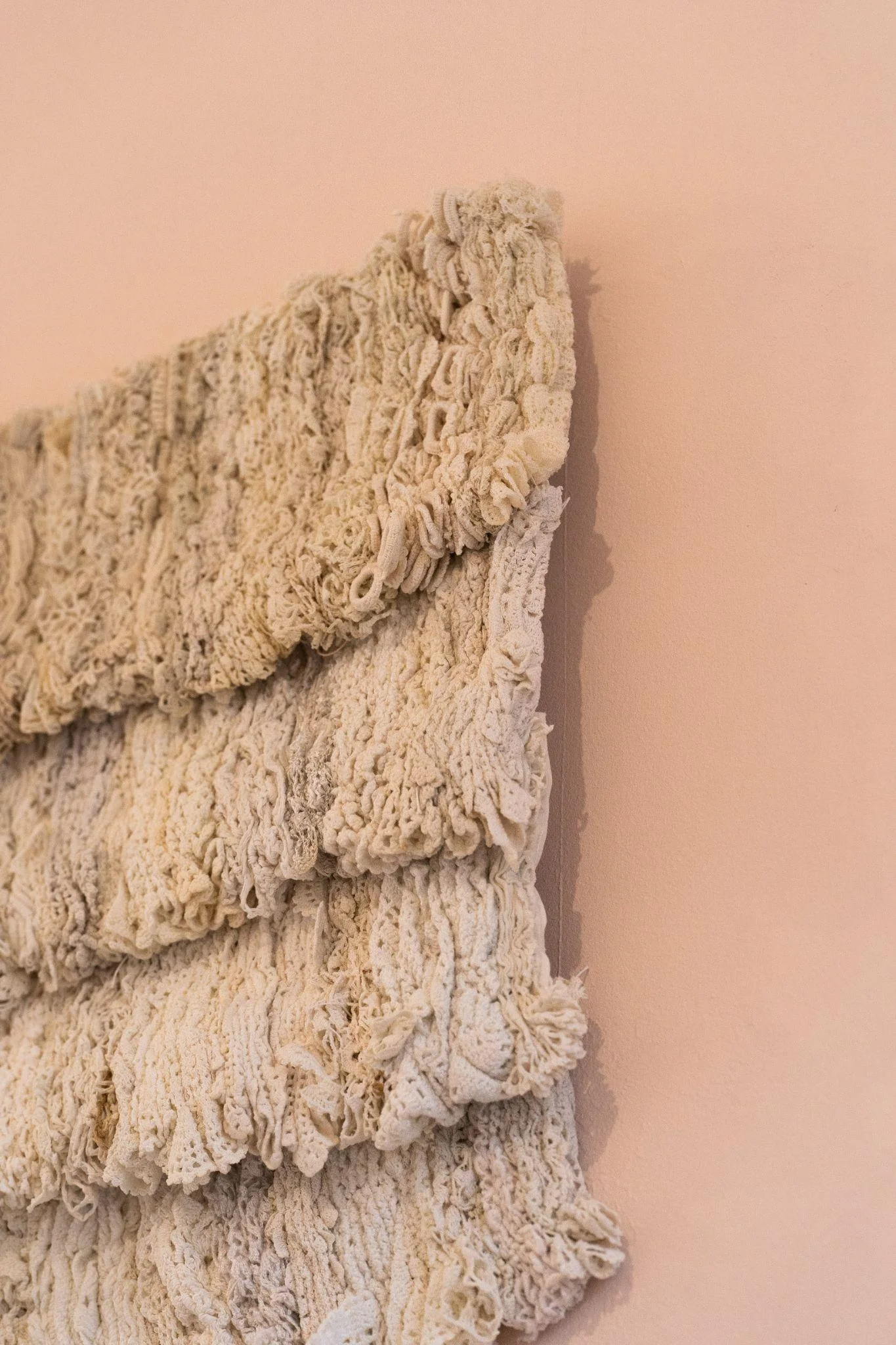
I have always been interested in the capacity of textiles to hold stories.
A textile is never simply a surface. It is the accumulation of gestures, time and material decisions. Every stitch belongs to a sequence, every repeated movement contributes to a larger structure. In this sense, textile-making is inherently connected to memory. Something is made gradually, considering its past and through the continuation of an action, and the resulting object can remain long after the act of making has ended.
The object and the person behind it
A handmade textile carries the stories of its maker. Its construction records repetition, patience, skill, stories even when some of its elements are not immediately visible. The finished object can appear complete and silent, while the labour that produced it remains largely unseen.
This became an important question within my research into women and textiles. Historically, many textile practices were situated within the domestic sphere and were understood as forms of women's work rather than as artistic production. Their practical function often contributed to their cultural and aesthetic devaluation.
I became interested in this gap between the object and the history contained within it.
What remains when the person who made something is no longer present?
What happens to the knowledge embedded in a technique when it passes from one generation to another?
And can an artwork make some of these hidden histories visible again?
Inherited materials
This is also why inherited textiles interest me.
In my research into Greek textiles traditions, the semedakia are strongly present: handmade crocheted textiles that were produced within Greek households and often displayed within the home. Their intricate surfaces required considerable time and technical knowledge, yet their association with domestic life placed them within a category of labour that was frequently overlooked.
When I encounter these objects, I am interested not only in their appearance but in everything that surrounds them.
Who made them?
Who taught them how?
How many hours were spent producing them?
What conversations took place while they were being made?
What happens when the person who made them is no longer there?
The textile remains.
The story becomes more difficult to access.
Making the invisible present
My work often begins with this tension between what can be seen and what remains hidden.
I am drawn to materials that already contain histories, but I also want to disrupt their familiarity. A textile can be transformed into a drawing, incorporated into a sculpture, embedded in concrete or translated into another material.
The object changes, but something of its previous life remains.
This is perhaps what I mean when I think about stories held in cloth.
The story is not necessarily visible.
It might exist in the repetition of a stitch, in the wear of a surface, in a technique passed between generations, or simply in the knowledge that another person's hands once made the object.
I am interested in that space between material and memory, between what an object tells us and what it leaves unsaid.
For me, textiles are compelling precisely because they can hold both.